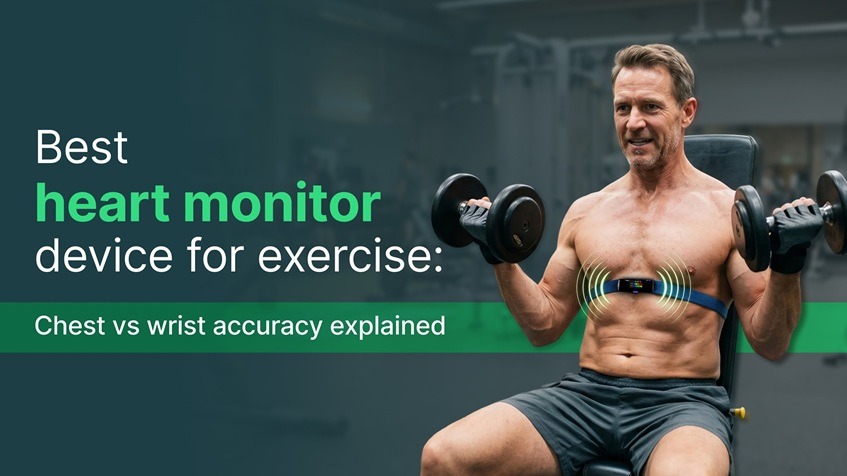

You finish a hard interval session feeling completely exhausted, but your smartwatch still shows your heart rate sitting comfortably in recovery range.
Sound familiar?
For runners, cyclists, and serious athletes, inaccurate heart rate tracking can quietly affect training quality, recovery, pacing, and long-term performance progression. The problem is often not your effort. It is how your device measures your heart.
Heart rate tracking has become a core part of modern training, but not all monitors work the same way. Some devices estimate heart rate from the wrist using optical sensors, while others use chest-based ECG technology to measure the heart’s electrical activity directly. During easy workouts, the difference may seem small, but as training intensity rises, the gap in accuracy becomes much harder to ignore.
Why Heart Rate Accuracy Matters During Exercise
Heart rate is not just a fitness number. It reflects how hard your cardiovascular system is working in real time.
People use heart rate monitoring to:
- Stay within training zones
- Improve endurance
- Manage recovery
- Avoid overtraining
- Track interval intensity
- Measure workout strain
But all of those decisions depend on one thing: Reliable data.
If your heart rate reading is delayed, artificially smoothed, or affected by movement, your training decisions can shift away from the intended goal without you realizing it.
That becomes especially important during:
- HIIT workouts
- Sprint intervals
- VO2 max intervals
- Tempo runs
- Strength circuits
- Cycling climbs
- Threshold sessions
Wrist-Based Heart Rate Monitoring: Convenient but Limited
Consider a marathon athlete completing a 20-mile aerobic long run. The goal is simple: stay in Zone 2 to preserve glycogen, build endurance efficiency, and accumulate controlled aerobic stress without drifting into unnecessary fatigue. On paper, that sounds straightforward. In practice, it depends entirely on how accurately your heart rate is measured.
Most smartwatches and fitness bands use PPG (photoplethysmography), an optical method that estimates heart rate using light. The sensor shines light into the skin and interprets changes in blood flow to estimate pulse rate.
This works reasonably well during:
- Walking
- Easy cardio
- Steady-state exercise
- Daily activity tracking
The biggest advantage is convenience; you simply wear the device on your wrist and start moving. That simplicity is why devices like the Apple Watch and WHOOP have become popular among active users.
But exercise creates conditions that can interfere with optical tracking.
Why Wrist Sensors Struggle During Exercise
Most smartwatches and fitness bands use optical sensors placed on the wrist. These sensors estimate heart rate by measuring changes in blood flow beneath the skin. During steady activities like walking or easy jogging, they can work reasonably well.
But exercise is rarely steady.
During intervals, strength training, cycling, rowing, or fast-paced workouts, wrist-based sensors often struggle because of:
- Rapid changes in intensity
- Arm movement and vibration
- Muscle tension and gripping
- Sweat and shifting skin contact
As a result, readings may become delayed, inconsistent, or artificially smooth during the exact moments athletes need accuracy the most.
Why More Athletes Are Switching to Chest-Based ECG Monitoring
Devices like Frontier X2 are designed specifically for athletes who need more reliable heart data during exercise.
Instead of estimating pulse from the wrist, Frontier X2 captures the heart’s electrical activity directly from the chest. This allows it to deliver faster and more stable readings during:
- Interval training
- Endurance sessions
- Strength workouts
- Cycling
- High-intensity exercise
Because the signal comes directly from the chest, it remains more consistent even during movement, sweat, and rapid intensity changes. For athletes training with heart rate zones, pacing targets, or structured workouts, that added stability can make training decisions feel far more reliable
These differences become even more noticeable as workouts become more structured and performance-focused.
Chest-Based EKG Monitoring: Measuring the Signal at the Source
Chest-based monitors work differently; instead of estimating pulse from blood flow, they measure the electrical activity generated by each heartbeat directly from the chest.
This is the same fundamental principle used in EKG monitoring. Because the signal comes directly from the heart:
- Response time is faster
- Readings stay more stable during movement
- Intensity changes are captured more accurately
This is why chest heart rate monitors remain widely used in:
- Endurance training
- Sports science
- Elite performance settings
- High-intensity exercise environments
Why EKG During Exercise Matters
As training intensity increases, small inaccuracies become more important.
Imagine doing VO₂ max intervals. Your effort changes rapidly between recovery and maximum intensity, and if your monitor responds slowly:
- You may push too hard during recovery
- Or not hard enough during work intervals
Over time, this changes the quality of the session itself.
The same applies to:
- Threshold workouts
- Heart rate zone training
- Recovery runs
- Cycling climbs
- Tempo sessions
EKG during exercise helps reduce those inconsistencies by capturing heart activity beat by beat, even during movement.
Chest Strap vs Wrist Watch: Real-World Training Differences
The difference becomes clearer in real training situations.
| Wrist-Based Tracking | Chest-Based EKG Monitoring |
|---|---|
| Estimates heart rate using blood flow | Measures electrical heart activity directly |
| Can lag during rapid intensity changes | Captures effort changes immediately |
| More affected by movement and sweat | Stable during high-intensity exercise |
| May smooth spikes and drops | Shows real-time fluctuations accurately |
| Best for convenience and casual tracking | Better suited for structured training |
This is why many athletes use a chest heart rate monitor even when they already own a smartwatch. The watch provides convenience, but the chest-based signal provides confidence.
Where Frontier X2 Fits In
Frontier X2 is designed for people who want more reliable heart data during exercise without sacrificing usability.
It is a chest-worn device that records EKG and heart rate during workouts, recovery, and daily activity.
Because it captures electrical activity directly from the chest, it provides stable heart rate tracking even during:
- Intervals
- Long runs
- Cycling climbs
- Strength training
- High-intensity sessions
This allows users to:
- Train within more accurate zones
- Understand effort more clearly
- Track recovery trends with greater consistency
Why Accuracy Matters More for Serious Training
At lower intensities, small heart rate errors may not feel significant, but structured training depends on precision.
A 10 bpm error can shift you from:
- Easy aerobic effort → Tempo intensity
- Controlled threshold → Unsustainable strain
- Recovery work → Accumulated fatigue
Over weeks of training, these small shifts af
- Adaptation
- Recovery
- Workout quality
- Endurance development
This is why more serious athletes move toward chest-based monitoring as training volume and intensity increase.
Heart Rate Zones Depend on Reliable Inputs
Training zones are built around heart rate, but if the measurement itself is inconsistent, the zones lose meaning.
Accurate EKG-based monitoring helps improve:
- Zone 2 training precision
- Threshold workouts
- VO₂ max sessions
- Recovery management
- Maximum heart rate tracking
This creates more consistent training across an entire training block.
Beyond Performance: Better Awareness During Exercise
Heart rate monitoring is no longer only about pace or calories, as more people want to understand how their heart responds during:
- Stress
- Fatigue
- Recovery
- Long training sessions
Stable EKG-based monitoring gives a clearer picture of those responses over time, and that awareness can help users:
- Recognize unusual effort patterns
- Understand recovery trends
- Train with greater confidence
Convenience vs Confidence
Wrist-based devices are popular because they are easy to wear. For casual activity tracking, they may be enough, but as training becomes more structured, users often begin asking different questions:
- Can I trust this number during intervals?
- Is this actually my real effort?
- Why does my heart rate feel delayed?
- Why does recovery seem inconsistent?
That is where chest-based EKG monitoring becomes valuable, not because it adds complexity, but because it improves the quality of the signal itself.
Who Benefits Most from Chest-Based Monitoring?
Chest-based EKG monitoring is especially useful for:
- Marathon runners
- Cyclists
- HIIT athletes
- Strength trainees
- Zone-based endurance athletes
- Users focused on HRV and recovery
It is particularly valuable when workouts involve:
- Rapid intensity shifts
- Heavy movement
- Long-duration effort
- Structured heart rate training
Final Perspective
The best heart monitor for exercise depends on what you expect from your data. If your goal is simple activity tracking, a wrist-based device may feel convenient enough.
But if your training depends on accurate heart rate zones, interval precision, recovery tracking, and reliable effort measurement, chest-based EKG monitoring offers a clear advantage.
Because when intensity rises, the quality of the signal matters more.
Frontier X2 brings that chest-based EKG accuracy into everyday training, helping athletes and active individuals move beyond estimated effort toward more reliable insight into how their heart actually responds during exercise.