

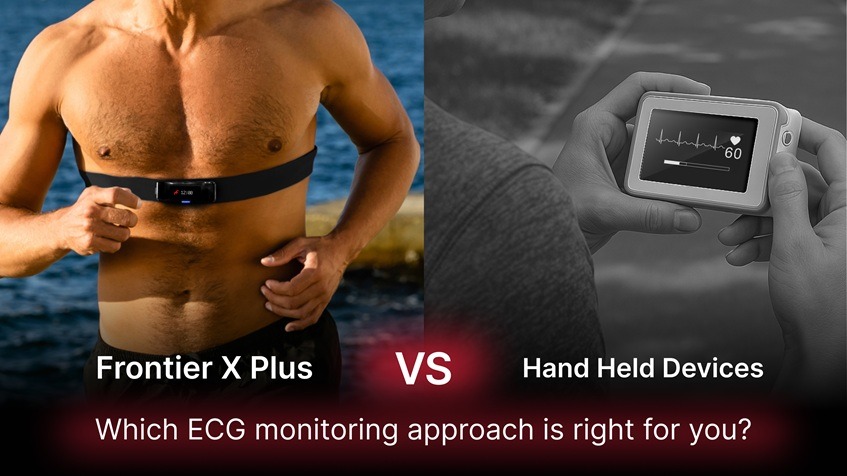
When it comes to understanding your heart, especially your heart rhythm and rate, the tool you use matters. Many people reach for handheld ECG devices because they are easy and affordable. But if you truly want a longer, more reliable view of your heart’s behaviour – including during activity and sleep – you may want to compare that with a medical-grade long-term ECG monitor like Frontier X Plus.
Here, we’ll break down the difference between Frontier X Plus and handheld ECG devices, explore how each works, and help you figure out which solution fits your health goals.
Key terms you’ll see in search results and throughout this article include heart monitoring, long-term ECG monitoring, medical-grade ECG, handheld ECG device accuracy, detecting irregular heartbeat, and long-term heart monitoring.
What Is a Handheld ECG Device?
Handheld ECG devices are portable tools designed to give you a quick snapshot of your heart’s electrical activity. You place your fingers on the electrodes and hold still for a short ECG reading. These devices are often used to check for:
- Normal heart rhythm
• Possible irregular beats during symptomatic moments
• Spot checks when you feel palpitations
They are popular because they are small, inexpensive, and require no prescription.
However, they have some important limitations:
- They only capture ECG when you actively record
• They often miss events during activity or sleep
• They may not detect intermittent rhythm changes
• They rely on proper finger placement and stillness for accuracy
Because of these constraints, handheld ECG devices work best for spot checks, not for continuous rhythm monitoring over time.
What Is Frontier X Plus?
Frontier X Plus is a prescription medical-grade ECG monitor that is FDA 510(k) cleared for long-term ambulatory monitoring. It is designed to be worn comfortably on the chest and records a continuous single-channel ECG signal over extended periods – from 24 hours up to 30 days – while you go about your life. For extended monitoring periods, the device is designed to be recharged approximately every 24 hours to ensure uninterrupted ECG recording.
The device is intended to capture heart rhythm trends during:
- Daily activities
• Exercise and exertion
• Sleep and rest
• Stressful moments
Unlike a handheld device, Frontier X Plus does not require you to pause or press a button to record your ECG.
FDA Clearance and Clinical Validation
One major difference between Frontier X Plus and many handheld ECG devices is FDA clearance. Frontier X Plus has received U.S. FDA 510(k) clearance as a medical device – meaning regulatory bodies have reviewed its safety and performance for ambulatory ECG monitoring.
Frontier X Plus has also been tested against conventional clinical ECG systems in both clinical and real-world settings. In studies evaluating rhythm classification, the device demonstrated 98.1% sensitivity and 97.88% specificity for detecting atrial fibrillation compared with a 12-lead ECG interpreted by independent cardiologists.
This means clinicians reviewing Frontier X Plus data can feel confident that the heart rhythm information is reliable and comparable with traditional ECG technology.
Continuous vs Spot ECG Data
The most important difference between Frontier X Plus and handheld devices is data continuity.
Handheld ECG Devices:
- Capture short ECG snapshots
• Require manual use
• Can miss asymptomatic or intermittent events
• Are limited to moments when you trigger a recording
Frontier X Plus:
- Continuously records ECG
• Captures data during activity and sleep
• Provides trend analysis over days
• Does not require you to remember to record
Your heart does not follow a schedule. Sudden arrhythmias or rate changes may occur when you least expect them – during a workout, overnight, or while walking. Long-termECG monitoring helps ensure you do not miss these events just because you were not holding a device at the time.
Activity and Exercise Monitoring
One of the areas where long-term ECG devices outperform handheld devices is during exercise.
Frontier X Plus is designed to record a reliable ECG even during movement, minimizing motion-related artifacts and helping clinicians evaluate how your heart behaves under stress.
Handheld devices often struggle with accuracy during motion because they require stillness and proper finger placement – something that is not possible during workouts or daily activities.
Sleep and Nocturnal Rhythm Assessment
Many rhythm irregularities occur during sleep, when your autonomic nervous system is active, and your body transitions between sleep stages. A heart rhythm test that only captures a few seconds here and there during the day is unlikely to pick these up.
Frontier X Plus monitors your heart overnight too, providing a fuller picture of your rhythm across different conditions. This can be especially useful if you suspect nocturnal palpitations, sleep-related breathing disorders affecting the heart, or unusual rate changes after midnight.
Handheld devices simply cannot be used during sleep.
Data Sharing and Clinical Integration
Another advantage of a medical-grade monitor like Frontier X Plus is remote data sharing with your physician. ECG recordings can be shared securely so that your clinician can review rhythm trends and provide informed guidance.
Many handheld ECGs let you save a single reading or export a file, but they often lack comprehensive remote monitoring and clinician-oriented workflow features.
Usability and Comfort
Handheld ECG monitors win in terms of size and convenience for occasional checks. They are compact and easy to use on the spot. But they cannot replicate the value of trend-based monitoring.
Frontier X Plus uses a comfortable, chest-worn design that you can wear through daily life – without adhesives or bulky wires – which improves long term compliance and comfort for extended monitoring.
When Each Option Makes Sense For You
Choose a handheld ECG Device If:
- You want quick spot checks
• You feel symptoms occasionally
• You need affordability and simplicity
• You do not require continuous monitoring
Choose Frontier X Plus If:
- You need extended ECG monitoring
• You have intermittent or unexplained symptoms
• You want rhythm patterns during exercise or sleep
• A clinician has recommended ongoing heart monitoring
For many people with ongoing heart rhythm concerns or those who want a deeper understanding of how their heart behaves over days, continuous ECG monitoring offers significant insight that a spot check cannot.
FAQs
What is the difference between a handheld ECG device and long-term ECG monitoring
Handheld ECG monitoring devices capture short spot recordings when you activate them. Long-term ECG monitors like Frontier X Plus record continuous ECG data over hours or days to capture trends and intermittent events.
Can handheld ECG devices detect atrial fibrillation
Handheld devices may detect atrial fibrillation during the moment you record, but they can easily miss events that occur outside that short window.
Is Frontier X Plus FDA-cleared
Yes. Frontier X Plus is cleared by the U.S. FDA as a long-termECG monitor intended to record, store, and transfer ECG rhythms for clinical evaluation.
Can ECG patch monitors be used instead of Frontier X Plus
ECG patch monitors also provide continuous recording over many days, but they are single-use and may involve adhesive-related discomfort or recurring costs. Frontier X Plus is rechargeable and reusable for convenience over multiple monitoring episodes.
Does long-term ECG monitoring detect more events than spot checks
Continuous monitoring records ECG data throughout your daily life, improving the chances of capturing intermittent arrhythmias and activity-related rhythm changes that spot checks might miss.
Related Posts
You might also like




-

Featured Articles
- Preparing for London or Boston Marathon? These Metrics...
 March 30, 2026
 - 10 Signs You Might Have Heart Disease
 March 24, 2026
 - The Best Way to Track Heart Rate in the Gym: Wrist...
 March 22, 2026
-
JOIN OUR NEWSLETTER
Get the latest articles, tips, offers & other exclusive content from Fourth Frontier.
