

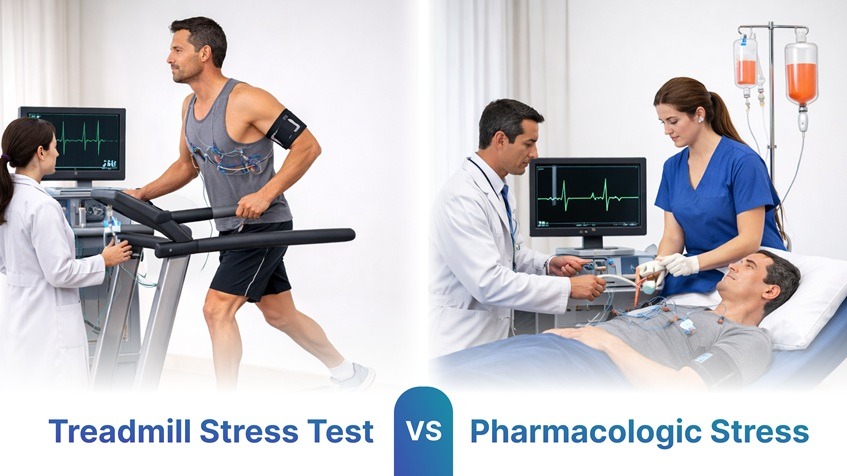
If your cardiologist has recommended a stress test, you might wonder whether you’ll be asked to walk on a treadmill or simply lie down while receiving medication that “stresses” your heart. Both tests aim to evaluate how your heart performs under strain – but the method, experience, and insights they provide differ significantly. Let’s explore what each type of stress test means, how they work, and which one might be more suitable for you.
What Is a Stress Test and Why Is It Done?
A cardiac stress test measures how your heart responds to exertion. During physical activity, your heart must pump harder and faster to supply oxygen-rich blood to your body. For some people, this added workload may reveal hidden signs of coronary artery disease (CAD), irregular heart rhythms, or inadequate blood flow that might not appear at rest.
Cardiologists typically recommend a stress test when you experience symptoms such as:
- Chest pain or discomfort during exertion
- Shortness of breath
- Unexplained fatigue
- Dizziness or irregular heartbeat
Treadmill Stress Test: The Traditional Approach
The treadmill (exercise) stress test is the most common type of cardiac stress test. It involves walking on a treadmill (or sometimes pedaling a stationary bike) while connected to an ECG machine. The treadmill gradually increases in speed and incline every few minutes to simulate increasing levels of exertion.
What It Measures:
- Heart rate and rhythm (via ECG leads on your chest)
- Blood pressure changes during activity
- Symptoms such as chest pain, fatigue, or breathlessness
- Oxygen consumption and recovery rate
What the Results Show:
This test helps doctors identify whether your heart is getting enough blood and oxygen during exercise. A normal result means your heart handles physical stress well, while abnormal results may indicate possible blockages in coronary arteries, poor exercise tolerance, or arrhythmias triggered by exertion.
Pharmacologic Stress Test: An Alternative for Non-Exercisers
A pharmacologic (chemical) stress test is designed for people who cannot safely perform physical exercise due to age, joint problems, or other health limitations. Instead of walking on a treadmill, medication is administered to make your heart react as if you were exercising.
Common drugs used include adenosine, regadenoson (Lexiscan), dobutamine, or dipyridamole. These medications increase blood flow or heart rate, simulating the effects of physical exertion.
What It Measures:
- ECG changes caused by the induced stress
- Blood pressure and heart rate response to the medication
- Blood flow patterns on imaging scans (if combined with nuclear or echocardiographic testing)
What the Results Show:
Just like the treadmill test, the pharmacologic version helps identify restricted blood flow, abnormal heart rhythms, and areas of the heart not receiving enough oxygen.
Treadmill vs Pharmacologic: Key Differences
| Feature | Treadmill Stress Test | Pharmacologic Stress Test |
| How it works | Physical exercise increases heart workload | Medication mimics exercise effects |
| Ideal for | Patients who can walk/run | Patients unable to exercise |
| Heart rate control | Natural increase with exertion | Drug-induced response |
| Imaging | Often ECG only | Often combined with imaging (echo or nuclear) |
| Duration | 10–15 minutes | 30–60 minutes |
| Preparation | Wear running shoes, avoid caffeine | Avoid caffeine and certain medications |
| Sensation | Physical fatigue or breathlessness | Warm sensation or chest tightness due to medication |
Which Test Is Right for You?
The decision depends on your physical ability, age, and overall cardiovascular risk. If you can walk comfortably, the treadmill test provides a more natural reflection of real-world exertion. However, if arthritis, balance issues, or other conditions prevent safe exercise, your doctor may recommend a pharmacologic stress test instead.
In some cases, a combination test (exercise stress test with echocardiography or nuclear imaging) may be used to obtain a clearer picture of how your heart muscle and blood flow respond to stress.
Understanding Your Results
Your cardiologist will interpret your stress test based on ECG readings, blood pressure response, and any reported symptoms. Possible outcomes include:
- Normal response: Your heart functions well under stress.
- Abnormal ECG patterns: Possible reduced blood flow or rhythm disturbances.
- Blood pressure changes: May indicate vascular or cardiac inefficiency.
- Exercise limitation: Could suggest cardiac or respiratory constraints.
Remember, an abnormal result doesn’t always mean a serious problem – it simply means further testing or evaluation may be required.
The Role of Continuous Heart Monitoring Between Tests
While stress tests provide a controlled snapshot of how your heart performs under exertion, your heart’s rhythm and function can vary widely during everyday activities – from climbing stairs and commuting to moments of rest and sleep.
That’s where long-term heart monitoring becomes invaluable.
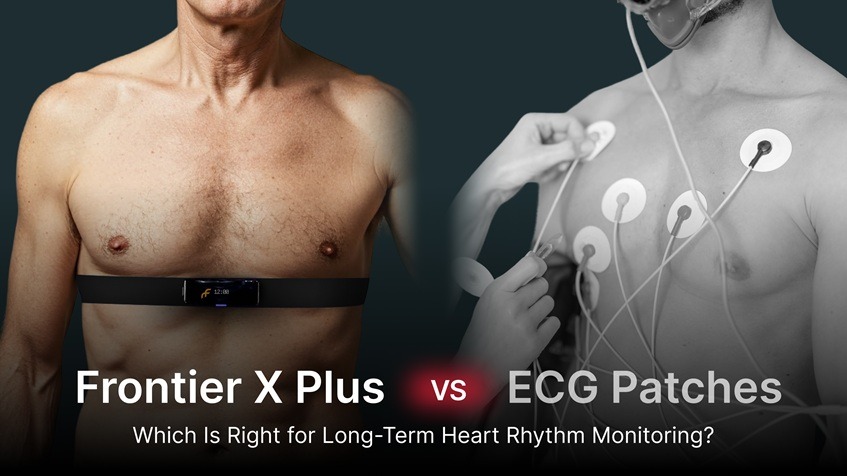
The Frontier X Plus is a medical-grade, FDA-cleared, prescription-based ECG monitor designed for extended recording of heart activity in real-world conditions. The data it captures can enable physicians to review rhythm patterns and assess overall cardiac performance over time, beyond what short-term clinical tests can show.
The Frontier X2, in contrast, is a wellness-grade ECG and heart rate monitor that helps users track exertion, recovery, and breathing patterns during workouts or daily routines.
Together, these devices provide complementary perspectives – one supporting physician-guided cardiac review and the other empowering personal health awareness – helping users and their care teams make more informed decisions about long-term heart health and fitness.
Lifestyle Tips to Support Heart Performance
Whether you’re preparing for a stress test or monitoring your heart at home, these tips can help you maintain cardiovascular strength and endurance:
- Exercise regularly: Aim for 150 minutes of moderate activity each week.
- Maintain a balanced diet: Focus on fiber, lean protein, and omega-3 fats.
- Avoid smoking and excess alcohol.
- Monitor blood pressure and cholesterol.
- Manage stress: Breathing exercises and mindfulness can regulate your heart rate.
- Get enough sleep: Poor sleep can raise heart rate variability and stress load.
FAQs on Stress Tests
- Is a treadmill stress test painful?
No. It involves gradual exertion under supervision, and you can stop anytime you feel uncomfortable. - How do I prepare for a stress test?
Avoid caffeine, alcohol, and heavy meals before the test. Wear comfortable clothing and follow your doctor’s medication instructions. - Which test is more accurate – treadmill or pharmacologic?
Both are reliable when done correctly. The choice depends on your ability to exercise and your cardiologist’s recommendation. - How long does it take to get results?
Initial ECG results are often available right after the test, but if imaging is involved, detailed reports may take a few days. - Can I monitor my heart trends at home?
Yes. You can track your heart’s activity at home using wellness tools like the Frontier X2, which records ECG and heart rate during daily routines or workouts – helping you observe personal trends in exertion and recovery.
For clinical oversight, the Frontier X Plus offers medical-grade, FDA-cleared, long-term ECG recording, enabling physicians to review and assess your cardiac rhythm patterns more comprehensively over time.
Final Takeaway
Both treadmill and pharmacologic stress tests are essential tools for evaluating heart function – one tests your physical endurance, the other your heart’s reaction to medication-induced stress. Whichever method your doctor chooses, it provides valuable insight into how well your heart handles strain.
And for those who wish to stay proactive between checkups, continuous ECG and heart rate tracking using tools like the Frontier X2 can help you better understand your wellness trends, fitness load, and recovery – empowering you to maintain a stronger, healthier heart.
Related Posts
You might also like


-

Featured Articles
- 10 Signs You Might Have Heart Disease
 March 24, 2026
 - The Best Way to Track Heart Rate in the Gym: Wrist...
 March 22, 2026
 - Why Body Shock Monitoring Is Crucial for Every Athlete
 January 7, 2026
-
JOIN OUR NEWSLETTER
Get the latest articles, tips, offers & other exclusive content from Fourth Frontier.
