
Fitness Tracking or Heart Health Monitoring? Why Frontier X2 Does Both
By: Fourth Frontier -
April 30, 2026 7:38 am

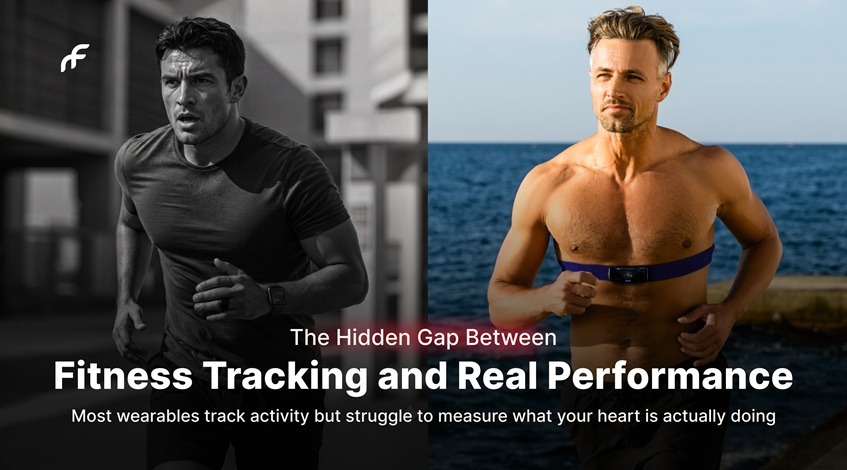

Most people think wearables are just fitness trackers, but that assumption leaves out something important. Some want a fitness tracker – something that logs workouts, tracks calories, and shows heart rate during exercise.
Others are more focused on heart health monitoring – understanding how their heart behaves over time, especially during stress, recovery, or daily life.
Traditionally, these have been two very different needs.
Fitness tracking is built around activity, whereas Heart monitoring is built around physiology. But today, that line is starting to blur. Because if you train regularly, your performance and your heart are not separate; they are deeply connected.
And that is exactly where Frontier X2 fits in.
Most wearables are designed with a primary focus.
| Fitness-First Devices | Heart-Focused Monitoring Tools |
|---|---|
| Steps, calories, and workouts tracking | Capture deeper physiological data |
| Estimated heart rate | Provide more detailed heart insights |
| Pace, distance, and activity tracking | Focus on long-term trends |
| Built for convenience and quick insights | Designed for deeper analysis |
| Heart rate may feel inconsistent during intense workouts | Not always designed for everyday training |
| Data may lag during intervals or sprints | Less integrated into active lifestyles |
| Recovery insights can feel unclear | Not built for performance tracking |
| Trends can be hard to trust | Often used more for observation than active training |
Whether your goal is performance, health, or both, one thing is constant: Your heart is at the center of it.
Every workout you do, every recovery day you take, every adaptation your body makes is reflected in how your heart responds.
If your device cannot capture that accurately, you are making decisions based on incomplete information.
This affects:
And over time, small inaccuracies can lead to inconsistent results.
Frontier X2 is designed to remove this trade-off.
It combines fitness tracking with high-quality heart data, so you can train and understand your body at the same time.
It is a chest-worn device that records ECG and heart rate during:
Because it measures the electrical activity of the heart directly, it provides a stable and consistent signal – even during high-intensity movement.
This changes how you experience both fitness tracking and heart monitoring.
Most fitness decisions depend on heart rate.
But not just any heart rate – accurate, real-time heart rate.
With Frontier X2, you get:
This helps you train with confidence, not guesswork.
Over time, this improves training consistency.
Your max heart rate defines your entire training structure.
If it is inaccurate, everything shifts.
Frontier X2 helps you:
Heart Rate Variability (HRV) reflects how your body is handling stress and recovery.
With ECG-based data:
This helps you decide:
Metrics like VO₂ max and threshold effort depend heavily on heart rate accuracy.
With better data:
Beyond performance, Frontier X2 gives you something most fitness trackers don’t: A clearer view of how your heart behaves over time.
Instead of just seeing numbers, you start noticing patterns:
This adds context to your training.
Heart health is not about a single reading.
It is about patterns across days and weeks.
With consistent use, you can observe:
This helps you understand your baseline.
Unlike occasional measurements, Frontier X2 works during:
This gives you a more complete picture of your heart.
At the core of both fitness tracking and heart monitoring is one thing: Signal quality.
If the signal is inconsistent:
If the signal is stable:
Frontier X2 is designed for people who want more than surface-level tracking. Built for serious training and used by marathoners and endurance athletes, it is especially useful if you:
It is especially useful if you:
It is not about complexity. It is about clarity.
Frontier X2 adds value across different types of training:
Wearables are evolving. The focus is no longer just on tracking activity; it is moving toward understanding effort, interpreting trends, and making better decisions from the data
That shift becomes clearer when you look at the difference:
Fitness tracking tells you what you did, but Heart monitoring helps you understand how your body responded. When both come together, your training becomes more informed, more controlled, and more consistent.
Frontier X2 brings these two worlds together in a way that fits into real training – not just lab conditions or casual tracking, because at the end of the day, it is not about collecting more data. It is about collecting better data – and using it to train smarter, recover better, and understand your body with greater clarity.




JOIN OUR NEWSLETTER
Get the latest articles, tips, offers & other exclusive content from Fourth Frontier.
