
Morning Readiness Score vs Overnight Readiness Score: Which Is More Accurate?
By: Fourth Frontier -
June 16, 2026 6:05 am

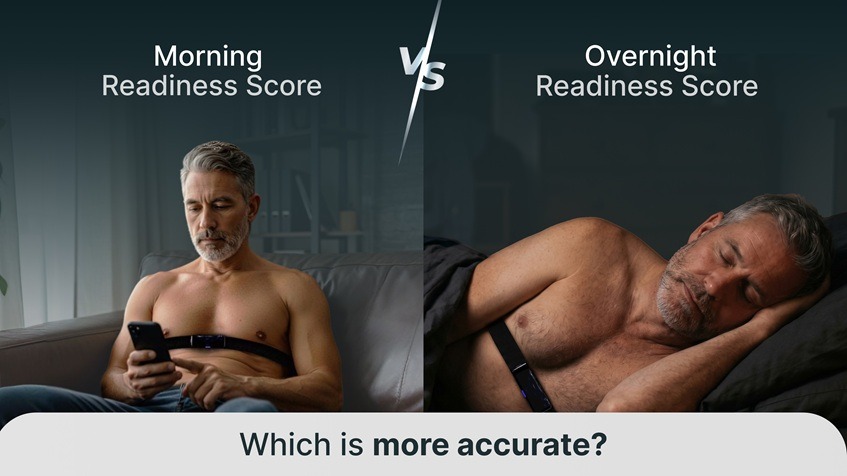
Every athlete has experienced it.
You wake up feeling refreshed, motivated, and ready to train. Your legs feel light, your energy is high, and mentally you are eager to push hard. Then you check your wearable, only to find a poor readiness score staring back at you.
Or the opposite happens.
Your device tells you that you are fully recovered and ready for a demanding workout, but your body feels sluggish, heavy, and far from prepared.
Moments like these raise an important question: how accurately do readiness scores reflect what is actually happening inside the body?
As wearables become more sophisticated, readiness metrics have become one of the most popular tools in endurance sports and fitness tracking. Athletes use them to decide whether to push harder, recover longer, or adjust training plans altogether.
But not all readiness scores are built the same way.
Some devices focus heavily on overnight recovery, while others place more emphasis on your current physiological state after waking. Understanding the difference can help athletes make better decisions and avoid relying too heavily on a single number.
Modern training is no longer just about logging miles, accumulating volume, or hitting workout targets.
Athletes are increasingly focused on balancing training stress with recovery. They want to know not only how hard they can train, but also how prepared their body is to absorb that training effectively.
This is where readiness scores entered the picture.
The goal of a readiness score is simple: estimate how prepared your body is for physical stress on a given day.
These scores typically combine information from factors such as:
The result is usually a simple score that attempts to answer one question:
“How ready am I to train today?”
The challenge is that different devices answer that question in different ways.
An overnight readiness score is calculated primarily using physiological data collected while you sleep.
Sleep provides a useful environment for recovery assessment because external influences are minimized. Movement is limited, environmental demands are lower, and the body is spending several hours in recovery mode.
Most overnight readiness systems evaluate:
Because these measurements are collected over several hours, overnight scores often provide a broad view of how the body recovered from previous training and daily stress.
In many cases, this creates a stable recovery baseline that is less influenced by temporary fluctuations.
The biggest advantage of overnight readiness scoring is consistency.
Rather than relying on a brief measurement window, these systems gather information across an entire night.
This helps identify trends such as:
For endurance athletes, these trends can be extremely valuable because training adaptations occur over days and weeks rather than hours.
A single workout rarely determines performance.
Recovery patterns over time often matter much more.
Despite their strengths, overnight readiness scores have one important limitation; they reflect how the body recovered overnight, not necessarily how it feels right now.
A lot can happen between waking up and starting a workout.
For example:
An overnight score cannot fully account for everything that happens after the recovery window ends.
This is why some athletes occasionally experience a mismatch between what the score suggests and how they actually feel.
Morning readiness scoring attempts to measure how prepared the body is at the time you begin your day.
Instead of relying solely on overnight trends, morning assessments often incorporate physiological measurements collected shortly after waking.
These measurements may include:
The goal is to capture a more immediate snapshot of readiness.
Rather than asking, “How did I recover overnight?” the question becomes:
“How ready am I right now?”
Many athletes find morning readiness scores easier to relate to because they align more closely with how the body feels in the moment.
For example, a poor night’s sleep, elevated stress, dehydration, or lingering fatigue may be reflected more clearly in a morning assessment.
This creates a score that feels more actionable because it is closer to the actual training decision.
Athletes can compare:
This combination often creates better context than relying on overnight data alone.
The biggest mistake athletes make is treating readiness scores as absolute truth. No readiness algorithm can fully capture every factor influencing performance.
Training readiness is affected by:
A readiness score can identify trends and provide useful guidance, but it cannot completely replace self-awareness.
This is why elite athletes often combine objective metrics with subjective feedback.
The number matters.
But so does how the body feels.
Most readiness systems ultimately rely heavily on cardiovascular data.
This is because the heart responds quickly to changes in:
Metrics such as resting heart rate and HRV often provide some of the earliest indications that recovery may be improving or declining.
This is one reason heart-focused monitoring has become increasingly important in performance tracking.
The quality of the readiness score depends heavily on the quality of the physiological data feeding it.
A readiness score is only as reliable as the measurements used to generate it.
If heart-rate measurements are inconsistent, delayed, or noisy, the resulting recovery assessment may become less reliable as well.
This becomes especially important for athletes who train frequently and use readiness metrics to guide intensity decisions.
Small inaccuracies may not seem significant on a single day.
Over weeks and months, however, they can influence:
The better the underlying physiological data, the more confidence athletes can have in the trends they observe.
Frontier X2 is a chest-worn device that records ECG and heart rate during exercise, recovery, and daily activity. Because it captures electrical heart activity directly from the chest, it provides stable cardiovascular data that can help athletes better understand how their body responds to training stress and recovery.
For athletes who pay close attention to readiness, recovery, and long-term performance trends, this creates additional context beyond simple activity tracking.
Instead of focusing only on workouts, users can observe how their cardiovascular system responds across:
This broader perspective helps create a more complete picture of performance readiness over time.
The answer depends on what you mean by “accurate.”
If the goal is understanding how well the body recovered overnight, overnight readiness scores often provide a strong foundation because they analyze several hours of physiological data collected during sleep.
If the goal is understanding how prepared the body is at the moment training begins, morning readiness assessments may feel more relevant because they capture a more immediate physiological snapshot.
In reality, these systems are not competing with each other.
They are answering slightly different questions.
Overnight readiness asks: “How well did I recover?”
Morning readiness asks: “How ready am I right now?”
Both perspectives can be useful when interpreted together.
As wearable technology evolves, athletes are becoming less focused on individual numbers and more interested in understanding trends.
A readiness score is valuable because it simplifies complex physiology into a practical metric.
But performance is never determined by a single number.
Successful athletes look at:
Because ultimately, readiness is not about chasing a perfect score.
It is about understanding how the body responds to stress and making smarter training decisions as a result.
Morning readiness scores and overnight readiness scores both provide valuable insights, but they are designed to answer different questions.
Overnight assessments help explain how the body recovered during sleep. Morning assessments provide a more immediate view of how prepared the body may be for the day ahead.
Neither is perfect on its own.
The most useful approach is to view readiness as a combination of recovery trends, cardiovascular data, training history, and personal awareness rather than relying on a single number.
Because in endurance training, success rarely comes from one workout or one score. It comes from making consistently good decisions over time, and understanding readiness is one more tool that can help guide those decisions.








JOIN OUR NEWSLETTER
Get the latest articles, tips, offers & other exclusive content from Fourth Frontier.
