

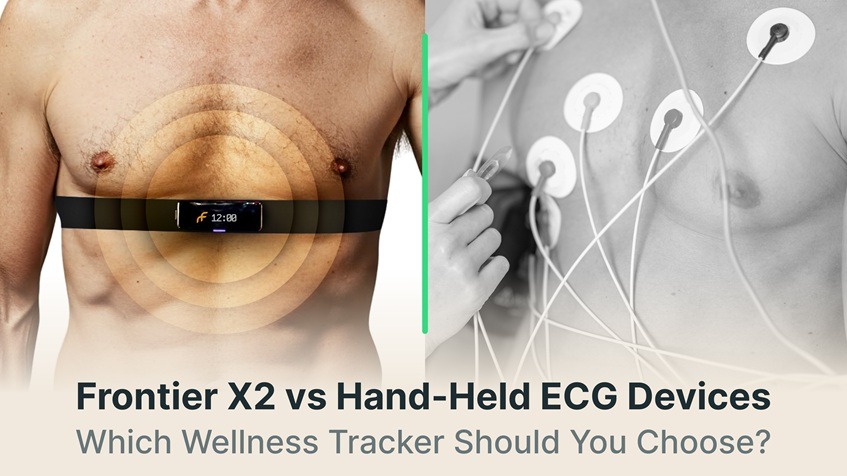
In today’s world of connected wellness technology, monitoring heart patterns is no longer limited to clinical settings. Wearables and portable sensors now allow individuals to track their heart performance in everyday life. But not every device offers the same kind of data or purpose.
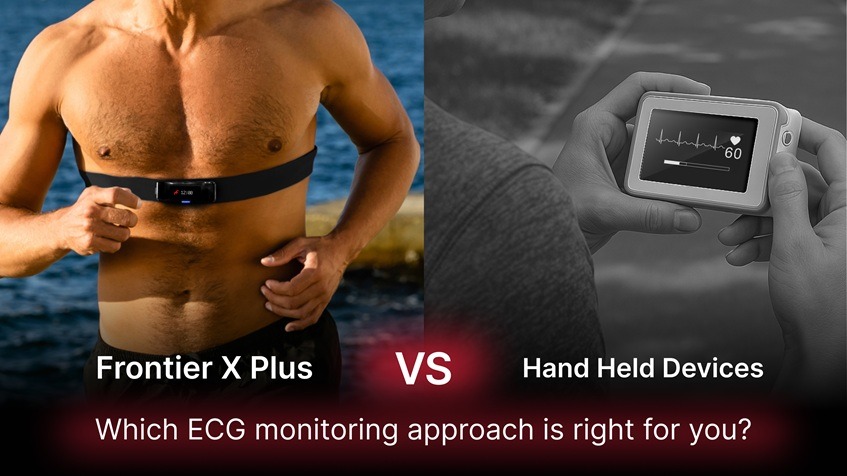
If you’re deciding between a chest-strap wellness monitor like the Frontier X2 and a hand-held ECG device, here’s a clear comparison – focused on wellness and performance insights, not clinical diagnosis.
What the Frontier X2 Offers for Wellness Tracking
The Frontier X2 is a wellness-grade smart heart monitor designed for users who want a deeper understanding of their cardiovascular performance during exercise, rest, or recovery. It’s not meant for diagnosis or treatment, but rather for providing actionable wellness data that helps you optimize training and recovery.
Key features include:
- Long-term ECG recording (24 hours per single charge of 1 hour) during daily activities, rest, and workouts.
- Live ECG streaming and PDF export/share options for personal review.
- Measurement of heart rate, breathing rate, HRV (Heart Rate Variability), strain, and body shock (impact forces).
- Tracks 20+ activities (running, cycling, swimming, etc.) and integrates with major fitness platforms like Apple Health, Google Fit, Strava, and Garmin.
- Chest-strap form factor ensures stable signal quality with minimal motion artefacts.
- Up to 14 days of battery life for typical use or 24 hours of continuous ECG recording.
- Sweatproof and waterproof (IP67) design for reliable performance during workouts.
In essence, the Frontier X2 is for users who want to go beyond simple heart-rate monitoring and explore how their body responds to effort, stress, and recovery.
What Hand-Held ECG Devices Typically Offer
Hand-held ECG devices – those you hold in your hands or place fingers on – are designed mainly for quick, short-term rhythm checks. They’re portable and convenient but usually provide only a snapshot of heart rhythm instead of continuous trend data.
Common features include:
- Easy, quick recordings lasting from 30 seconds to a few minutes.
- Useful for checking basic rhythm patterns but not designed for long-term or exercise-based tracking.
- Limited motion tolerance – recordings typically need you to stay still.
- Compact design and simple operation for casual, at-home use.
They’re great for spot checks but offer less data depth for training or wellness analysis.
Side-by-Side Comparison (Wellness Perspective)
| Feature | Frontier X2 (Chest-Strap) | Hand-Held ECG Device |
| Long-term ECG recording during exercise | Yes – optimized for motion and workouts | Typically limited to still/spot checks |
| Training load & body shock metrics | Yes – provides advanced training insights | Usually not available |
| Integration with fitness apps | Yes – Apple Health, Strava, etc. | Limited connectivity |
| ECG quality under motion | Stable due to chest-based sensors | Often affected by hand movement |
| Comfort for casual use | Requires strap; best for active use | Very portable and discreet |
| Depth of wellness data | High – includes HRV, strain, readiness metrics | Moderate – focused on rhythm checks |
| Best suited for | Athletes, fitness enthusiasts, wellness seekers | Users wanting quick rhythm checks |
Which One Should You Choose?
Choose the Frontier X2 if you want to:
- Understand how your heart responds to exercise, stress, and recovery.
- Track training load, HRV, strain, and readiness to optimize performance.
- Review long-duration ECG trends across rest, activity, and sleep.
Choose a hand-held ECG device if you want to:
- Perform occasional rhythm checks.
- Have a small, easy-to-carry tool for basic heart pattern observations.
- Focus on convenience rather than data depth.
Many users actually combine both – using a hand-held device for quick rhythm spot checks and a chest-strap device like the Frontier X2 for training, sleep tracking, or detailed wellness analysis.
Important Wellness Considerations
- Neither the Frontier X2 nor most hand-held ECG devices are intended for diagnosis or treatment. They provide personal wellness data that can help you understand patterns and share observations with professionals if needed.
- Lifestyle factors such as sleep, nutrition, hydration, and stress levels significantly influence your heart metrics.
- Consistency and comfort are key – choose the device you’ll wear most regularly.
- Data interpretation matters: Use accompanying apps or coaching tools to turn numbers into actionable wellness insights.
FAQ
Q1: What’s the difference between a chest-strap monitor and a hand-held ECG device?
A: A chest-strap monitor like the Frontier X2 provides extended ECG and multi-metric wellness data during activity, while a hand-held ECG device is best for short, stationary rhythm checks.
Q2: Can a hand-held ECG replace a smartwatch or chest strap for wellness tracking?
A: Not fully. Hand-held devices are ideal for quick checks, but a chest-strap device like the Frontier X2 captures more continuous data on performance, HRV, and recovery.
Q3: Why choose extended ECG monitoring when I already have a smartwatch?
A: Smartwatches typically measure heart rate via optical sensors (PPG) and give brief ECGs. The Frontier X2 uses electrodes on the chest for a clearer signal during workouts and rest, making it more comprehensive for performance tracking.
Q4: Does the Frontier X2 provide medical-grade ECG?
A: The Frontier X2 is a wellness-grade device intended for fitness and wellness purposes. It is not a diagnostic or medical-grade tool.
Q5: Who should consider using the Frontier X2?
A: Individuals who want to explore how their heart behaves under different stress and activity levels – such as athletes, trainers, and health-conscious users seeking deeper insights into their body’s responses.
Related Posts
You might also like


-

Featured Articles
- Preparing for London or Boston Marathon? These Metrics...
 March 30, 2026
 - 10 Signs You Might Have Heart Disease
 March 24, 2026
 - The Best Way to Track Heart Rate in the Gym: Wrist...
 March 22, 2026
-
JOIN OUR NEWSLETTER
Get the latest articles, tips, offers & other exclusive content from Fourth Frontier.
