
Why Wrist Heart Rate Fails During HIIT (And What to Use Instead)
By: Fourth Frontier -
June 5, 2026 5:32 pm

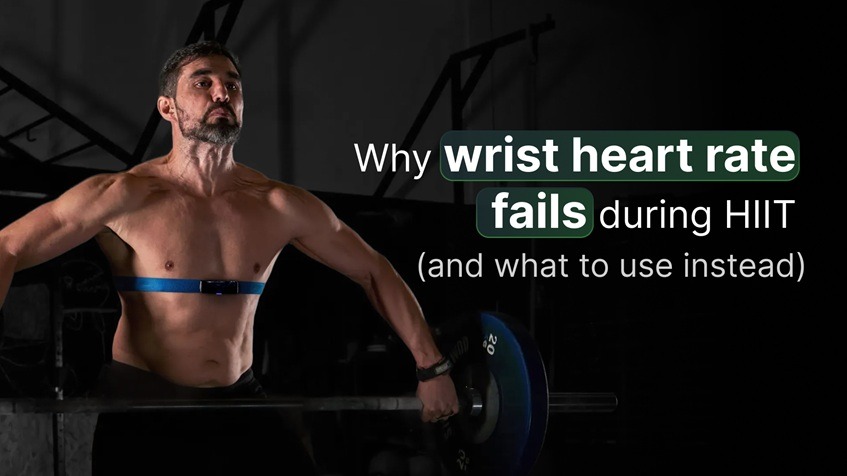
HIIT is controlled chaos. One moment you are catching your breath, and seconds later you are sprinting, jumping, rowing, pushing, or lifting at near-maximum effort. Your body shifts gears fast, and your heart has to respond just as quickly. That constant rise and fall in intensity is exactly what makes high-intensity interval training so effective for building conditioning, endurance, and performance.
But it also reveals something many people never notice until they start training seriously: most wrist-based heart rate trackers struggle to keep up.
During steady activities like walking or easy jogging, wrist sensors may seem perfectly fine. But HIIT is different. The pace changes suddenly, movement becomes explosive, and heart rate climbs rapidly. In those moments, wrist-based readings often become delayed or inconsistent.
And in a workout built around seconds, even a small delay changes the story your data is telling.
HIIT workouts are designed around effort, not just movement. The goal is to reach specific levels of cardiovascular stress and recovery within short windows of time, which is why HR plays such an important role in structured interval training.
People use heart rate during HIIT to:
But these decisions only work if the HR data reflects what your body is actually doing in real time. If the signal lags behind your effort, the feedback guiding your training becomes far less reliable.
Most smartwatches and fitness bands use optical sensors, also called PPG (photoplethysmography). These sensors shine light into the skin and estimate pulse by measuring changes in blood flow.
At rest or during smooth, steady exercise, this method can work reasonably well. That is why wrist-based devices are popular for daily activity tracking, walking, easy cardio, and general fitness monitoring. The convenience is undeniable. You wear the watch, start your workout, and instantly see your heart rate.
The challenge is that HIIT creates conditions that optical sensors struggle to handle consistently.
HIIT combines rapid movement, muscle tension, sweat, and sudden effort changes, all of which interfere with wrist-based optical tracking. Several factors contribute to this problem.
HIIT intervals can shift from recovery to maximum effort within seconds. Optical sensors often respond too slowly to capture those transitions accurately, especially when HR rises very quickly.
As a result:
By the time the watch reflects your true heart rate, the interval may already be over.
HIIT workouts involve constant arm movement through exercises such as:
These movements create vibration and wrist motion that interfere with optical readings. This can lead to sudden drops in heart rate, unrealistic spikes, or fluctuating numbers that simply do not match your actual effort.
During lifting or explosive exercises, wrist muscles tighten and blood flow changes. Because wrist sensors depend on blood flow measurement, these changes can distort the signal.
You may feel your heart pounding during a hard interval while your watch still shows a surprisingly low number. Over time, this makes it difficult to trust the data during intense sessions.
Sweat buildup and shifting contact between the device and skin can reduce signal quality even further. During demanding workouts, small movements of the watch can affect how consistently the sensor reads blood flow.
This becomes especially noticeable during longer HIIT circuits where movement, heat, and sweat continuously increase.
A small heart rate delay might seem harmless at first. But in HIIT, workouts are built around very short windows of effort and recovery. If your monitor misses the true intensity of a 30-second sprint interval, it changes how you interpret the entire session.
Over time, inaccurate readings can lead to:
For athletes training with structure and progression, those small errors can compound quickly.
Many wrist-based devices smooth heart rate fluctuations to reduce visual noise. While this creates cleaner-looking graphs, it can also hide what is actually happening physiologically during interval training.
HIIT is not smooth. Heart rate rises rapidly during work intervals and falls rapidly during recovery. When those spikes are artificially flattened:
Instead of seeing how your body truly responded to the workout, you end up training from approximations rather than real-time physiology.
For high-intensity workouts, chest-based heart rate monitoring provides a more reliable solution. Unlike wrist sensors, chest monitors measure the electrical activity of the heart directly rather than estimating pulse through blood flow.
This ECG-based approach captures each heartbeat at the source, allowing intensity changes to appear much faster and more accurately. As a result:
That is why chest heart rate monitors continue to be widely used in HIIT training, endurance sports, performance coaching, and sports science environments where precision matters.
The difference becomes clear during real workouts.
| Wrist-Based Tracking | Chest-Based ECG Monitoring |
| Estimates heart rate using blood flow | Measures electrical heart activity directly |
| May lag during intervals | Captures rapid effort changes instantly |
| More affected by movement and sweat | Stable during explosive exercise |
| Can smooth spikes artificially | Reflects real-time heart response |
| Better for convenience | Better for training precision |
Convenience is useful, but during HIIT, precision matters more.
Frontier X2 is a chest-worn device that records ECG and heart rate during exercise, recovery, and daily activity. Because it captures electrical heart activity directly from the chest, it remains stable even during demanding workouts involving:
This allows users to train within more accurate heart rate zones, understand effort more clearly, monitor recovery between intervals, and avoid relying on delayed wrist-based readings.
For athletes and active individuals who use heart rate to guide HIIT intensity, this creates a more dependable training experience.
The effectiveness of interval training depends on how precisely effort and recovery are balanced. If your monitor reacts slowly, work intervals may not reach the intended intensity, recovery periods may become inconsistent, and fatigue becomes harder to manage.
Over time, that affects adaptation itself. Reliable heart rate data helps ensure the workout you planned is actually the workout your body performs.
Many people begin with wrist-based tracking because it is simple and accessible. But as training becomes more structured, the limitations become easier to notice.
Athletes often start asking:
In many cases, the issue is not the workout itself. It is the way heart rate is being measured.
As intensity increases, accuracy becomes more important. That is why many endurance athletes and performance-focused users eventually move toward chest-based ECG monitoring for demanding workouts.
HIIT places significant stress on the cardiovascular system. Understanding how your heart responds during these sessions can help you pace intervals more effectively, avoid excessive fatigue, recognize unusual responses to effort, and improve recovery planning over time.
Reliable ECG-based monitoring creates a clearer picture of those responses, especially during workouts where rapid intensity changes make accurate tracking more difficult.
HIIT training is built around precision: short work intervals, short recovery periods, and rapid changes in effort. When heart rate data lags behind those changes, training becomes much harder to interpret accurately.
Wrist-based trackers may work well for casual activity and steady exercise, but high-intensity workouts expose their limitations quickly. Chest-based ECG monitoring offers a more stable and responsive alternative by measuring the heart directly instead of estimating it through blood flow.
And when your training depends on timing, intensity, and recovery, that difference becomes more than technical. It becomes part of how effectively you train.








JOIN OUR NEWSLETTER
Get the latest articles, tips, offers & other exclusive content from Fourth Frontier.
