

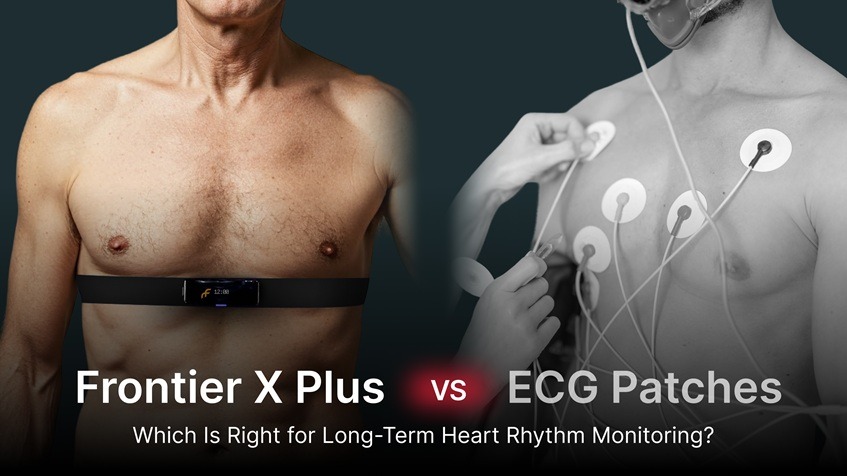
When you need to understand what your heart is doing over hours or days, how you monitor it matters. Both chest-worn systems, like the Frontier X Plus, and adhesive patch-based ECG monitors give long-term rhythm information, but they differ in comfort, cost, signal quality, clinical workflow, and practical use for athletes or patients. If you are deciding which is right for you, here is a clear comparison that explains the trade-offs and helps you choose based on your goals.
What each option is best at – the quick overview
Frontier X Plus
A prescription-based, medical-grade long-term ECG monitor designed for repeated, comfortable chest wear. Built for extended ambulatory recordings, clinicians use the device data to assess rhythms such as atrial fibrillation, tachycardia, and bradycardia and to track trends over time. It is reusable and designed to fit patient lifestyles.
ECG patches
Single-use or limited-duration adhesive patches that stick directly to the skin and record a single-lead ECG for several days up to two weeks. Patches are compact and discreet and have been shown in studies to improve diagnostic yield versus traditional Holter monitoring in some indications. They are typically consumable per study and are widely used for short to medium-term diagnostic monitoring.
Comfort and wearability: chest strap versus stick-on
Frontier X Plus
Designed as a lightweight chest-worn system that you don’t need to reapply each day. It avoids daily adhesive on sensitive skin and is made for repeated, comfortable use during activities. The chest placement helps keep electrodes stable even during exercise or movement.
ECG patches
Highly discreet and low profile. They adhere directly to the skin and are nearly invisible under clothing for the monitoring duration. But adhesive can irritate some users, and patches are single-use, so you replace them for each new monitoring episode. Patches can also lose adhesion if the skin is oily, sweaty, or if the patch placement is disturbed.
If your priority is long-term repeated monitoring without repeated adhesive application, a reusable chest option can be more comfortable long-term. If you want a one-off short study and invisible placement matters most, patches shine.
Signal quality and motion resilience
Chest-based sensors tend to maintain a stable contact vector and can give clean ECG traces during motion or exercise. This is useful if you need reliable data during daily life or workouts. Frontier X Plus was designed to provide high-fidelity ECG recordings suitable for clinical review.
Patch devices provide excellent recordings at rest and during routine activity and have improved diagnostic performance compared with older Holter systems in several studies. However, single lead patch orientation can limit some waveform detail (for example, small amplitude atrial signals), and adhesives can lose signal quality if dislodged.
Bottom line: both technologies can be clinically useful. If you plan frequent or high-motion activity while recording, choose the approach with proven motion resilience and stable contact for your use case.
Monitoring duration and logistics
Patches often record continuously for 7 to 14 days, depending on the product and battery. That makes them ideal for single-episode diagnostic windows where you suspect intermittent arrhythmia. They are disposed of after use and usually processed by a lab or clinic for reporting.
Frontier X Plus is intended as a prescription-based long-term monitoring solution that supports repeated ambulatory recordings and clinician review. Because it is reusable and chest-based, it fits workflows where ongoing trend review or multiple monitoring episodes are needed without a new adhesive device each time.
If you need a single diagnostic window of up to two weeks, then a patch is often practical. If you need recurring monitoring, trend tracking, or repeated studies, the reusable chest option can be more economical and convenient.
Cost and health system workflow
Patches are usually single-use and billed per application. That means recurring costs for repeated monitoring episodes. Patches are often processed through clinical labs and integrated into diagnostic workflows.
Reusable chest solutions offer a different cost model: the hardware is a one-time or subscription purchase and can reduce per-episode consumable costs. For clinics that monitor many patients or for people who require periodic monitoring, this can lower the total cost of ownership over time. Also, reusable devices reduce medical waste from disposable patches.
From an operational perspective, clinics choose the option that fits volume and billing preferences. For you as a user, think about whether you need a one-off diagnostic test or an ongoing monitoring relationship.
Data access, alerts, and clinical integration
Patch systems deliver continuous recordings that clinicians review after the monitoring period. They are excellent for diagnostic capture and are widely accepted by cardiology practices.
Frontier X Plus supports real-time data capture that clinicians can access for trend analysis, and it is designed for integration into clinical workflows for remote review. For people who want ongoing oversight and clinician accessible trend data, a prescription-based chest monitor supports that model.
If you want immediate alerts or clinician review over repeated monitoring windows, ask how each system routes data and whether your provider can view and act on trends quickly.
Practical use cases – when to pick which
Choose an ECG patch when
- You need a one-off diagnostic window of up to two weeks.
- You want minimal visible hardware and a single application.
- Your clinician intends to analyze the recorded session in a lab workflow.
Choose a reusable chest monitor like Frontier X Plus when
- You need repeated monitoring episodes or long-term trend awareness.
- You want a device built for daily life and higher motion activities.
- You prefer fewer consumables and lower recurring hardware costs over time.
Small clinical note on long-term rhythm monitoring
Long-term ECG monitoring helps clinicians observe rhythm patterns over real-world activities and rest. Different modalities add value in different clinical scenarios. Recent studies show adhesive patch ECGs can improve diagnostic yield in many cases versus older Holter monitors, while chest-based reusable systems offer a complementary option focused on repeatability, patient comfort, and clinic workflow
FAQs
Q1: Are ECG patches better than chest strap monitors for diagnosis
Patches are very good for single episode detection and have shown improved diagnostic yield over standard Holter recordings in some studies. Chest-based reusable monitors are better suited for repeated or activity-heavy monitoring.
Q2: Can a chest monitor be used during intense exercise
Yes, chest-based systems designed for clinical ambulatory use maintain electrode contact and signal quality during movement and are often preferred when you want reliable data during workouts.
Q3: How long can ECG patches record for
Many modern patches record continuously for seven to fourteen days, depending on the product and battery.
Q4: Are reusable chest monitors more cost-effective
For repeated monitoring episodes, reusable chest monitors usually lower overall costs because you avoid buying a new adhesive patch for each study. Check pricing and clinician workflow for specifics.
Q5: What should I discuss with my clinician before choosing a device
Talk about the monitoring duration you need, whether you will be active during recording, how often you require monitoring, and how you want data delivered to you and your care team.
The Frontier X Plus is an FDA 510(k) -cleared, prescription-based, medical-grade, long-term ECG monitor intended for clinician-supervised ambulatory use. The ECG data recorded by the device assists clinicians in reviewing heart-rhythm behavior – such as atrial fibrillation, tachycardia, and bradycardia – over extended durations and under real-world conditions, as part of an overall clinical assessment.
The Frontier X2, in contrast, is a wellness-grade, chest-worn device that records ECG and heart-rate metrics to provide trend-level insights related to training load, recovery, and cardiovascular response during exercise and daily activities. It is designed to help users better understand patterns over time rather than for medical evaluation or diagnosis.
Final thought
There is no one-size-fits-all. If you need a single diagnostic capture for a specific window, a patch is a powerful and discreet tool. If you need repeated monitoring episodes, a robust signal during activity, fewer consumables, and a clinician-integrated trend review, a medical-grade reusable chest monitor such as the Frontier X Plus may be the better fit. Talk with your clinician about the clinical question you are trying to answer and choose the device that matches that goal.
Related Posts
You might also like





-

Featured Articles
- Preparing for London or Boston Marathon? These Metrics...
 March 30, 2026
 - 10 Signs You Might Have Heart Disease
 March 24, 2026
 - The Best Way to Track Heart Rate in the Gym: Wrist...
 March 22, 2026
-
JOIN OUR NEWSLETTER
Get the latest articles, tips, offers & other exclusive content from Fourth Frontier.
