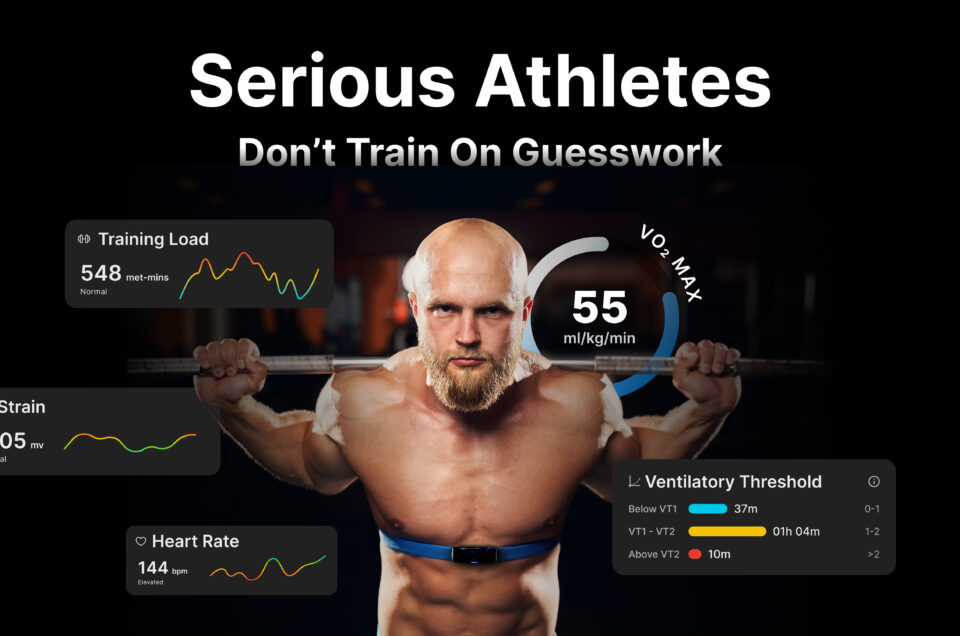

If you’re a serious athlete, you already know that tracking your workout goes far beyond distance, pace, or power – your heart is the engine driving all of it. Yet most mainstream smartwatches only scratch the surface, relying on optical sensors that can introduce small bpm errors. And small inaccuracies don’t stay small.
A slight misread can push you into the wrong training zone, distort your VO2 max estimate, miscalculate your VT (Ventilatory Threshold )zones, and misguide recovery decisions. That’s why more endurance athletes are moving beyond smartwatches and choosing a chest-based heart rate monitor that measures the heart’s electrical signals directly. When you push your body to extremes, accuracy isn’t optional – because when your heart rate data is wrong, your training is wrong.
Why Small Inaccuracies Matter More Than You Think
A smartwatch may show 162 bpm. Your actual heart rate might be 170 bpm.
That 8-beat difference can mean:
- Training in the wrong heart rate zone
- Miscalculating lactate threshold (VT zones)
- Underestimating maximum heart rate
- Distorted VO2 max calculations
- Inaccurate heart rate variability (HRV) readings
For casual fitness tracking, that may not matter. For serious athletes pushing threshold intervals, race pace efforts, or heat training sessions – it absolutely does.
When your heart rate data is off:
- Your pacing strategy is off
- Your recovery decisions are off
- Your long-term adaptation tracking is off
And over months of training, that compounds.
How Most Smartwatches Estimate Heart Rate (And Why Errors Happen)
Most smartwatches we wear today use a technology called PPG (photoplethysmography). In simple terms, it shines light into your skin, tracks changes in blood flow, and uses those pulse waves to estimate your heart rate. When you’re sitting still, going for an easy jog, or doing steady low-intensity work, it usually performs well enough. For general fitness tracking, it feels seamless and convenient – you glance at your wrist and get a number.
But if you’ve ever pushed through a hard interval session, a tempo ride, or a race effort, you may have noticed moments where the numbers just don’t feel right. Your breathing is labored, your legs are burning – yet your watch seems slow to catch up. That’s because during high-intensity training, wrist-based sensors can struggle. Natural arm movement creates motion noise, sweat interferes with sensor contact, tight grip on handlebars or weights changes blood flow patterns, and colder conditions reduce circulation in the wrist. Optical sensors can also lag when your heart rate spikes quickly during intervals.
For everyday tracking, that may not matter. But when you’re training with intention – targeting precise zones, chasing a new VO2 max, or dialing in your VT thresholds – those small inconsistencies can start to feel bigger. And as an athlete, you know the difference between “good enough” data and data you can truly trust.
PPG vs ECG: The Core Difference
| Feature | Wrist (PPG) | Chest (ECG) |
| Measures | Blood flow | Electrical heart signals |
| Motion resistance | Moderate | High |
| Beat-to-beat precision | Estimated | Direct |
| HRV accuracy | Limited | High |
| Interval training reliability | Variable | Strong |
A chest-based heart rate monitor using ECG reads the heart’s electrical impulse directly – the actual signal that triggers each beat.
That difference matters.
What Accurate Heart Rate Actually Means for Athletes
Accuracy isn’t about vanity metrics. It directly impacts:
VO2 Max Estimation: VO2 max calculations rely heavily on heart rate response. If heart rate is misread, VO2 max trends become unreliable.
VT Zones (Ventilatory Threshold Zones): Training around lactate or ventilatory thresholds requires precision. A few beats off shifts the metabolic stimulus.
Maximum Heart Rate Tracking: If your device underestimates your peak HR, your zones compress artificially.
Heart Rate Variability (HRV): HRV depends on exact beat-to-beat intervals. Optical estimation reduces reliability, especially during movement.
High-Intensity Intervals: Chest ECG responds instantly to changes. Wrist-based PPG often lags. For athletes optimizing performance, that precision translates into:
- Better pacing
- Smarter deload weeks
- Reduced overtraining risk
- Clearer readiness insights
Why Chest-Strap-based Heart Monitors are Non-negotiable for Serious Athletes
When marginal gains matter, data quality matters. Elite and high-level endurance athletes increasingly choose chest strap-based heart rate monitors because they:
- Provide more stable readings during motion
- Capture true beat-to-beat intervals
- Support accurate HRV analysis
- Improve training zone precision
- Reduce signal dropouts during sweat-heavy sessions
This is especially important in:
- Marathon training
- Ironman preparation
- Cycling threshold sessions
- HIIT workouts
- Heat-adapted training
Why Accuracy = Longevity
Training stress accumulates over time. If heart rate data is consistently underestimated:
- You may push harder than intended
- Recovery may be insufficient
- Overtraining risk increases
Accurate ECG-based monitoring supports:
- Smarter progression
- Clearer fatigue signals
- Better cardiovascular awareness
For athletes, thinking long-term – performance and health go together.
Where Frontier X2 Fits In
Frontier X2 is a chest-strap-based ECG monitor designed for athletes who prioritize data accuracy. It records ECG-derived heart rate and delivers:
- Near real-time heart rate tracking
- Maximum heart rate capture
- Heart rate variability
- VO2 max trends
- Ventilatory threshold zone insights
- Strain metrics
Connectivity Advantage
Unlike many chest straps:
- It can record sessions without a phone
- Sync data later
- Connect to multiple training apps
- Integrate into existing performance ecosystems
It is built for athletes who train hard, outdoors, and without always carrying a device.
Rather than positioning itself as a smartwatch replacement, it positions itself as an accuracy-first performance tool.
Key Takeaways
- Small heart rate inaccuracies compound over time
- Wrist PPG estimates pulse; chest ECG measures electrical activity
- Accurate heart rate improves VO2 max, VT zones, and HRV reliability
- A chest-based heart rate monitor offers stronger motion resistance
- Frontier X2 is designed for athletes who prioritize accuracy and connectivity
Frequently Asked Questions
Is ECG more accurate than PPG for heart rate monitoring?
ECG measures the heart’s electrical signals directly. PPG estimates heart rate from blood flow. During high-motion activity, ECG typically provides more stable and precise measurements.
Are smartwatch heart rate monitors reliable for zone-based training?
Smartwatches can be adequate for moderate activity. However, during intense training, optical sensors may experience signal degradation that affects zone precision.
Can continuous ECG help with HRV and readiness scoring?
Yes. ECG captures exact beat-to-beat intervals, which supports more accurate HRV analysis and recovery assessments.
Does continuous ECG replace clinical evaluation?
Medical-grade ECG devices used under physician supervision can complement clinical evaluation but do not replace comprehensive diagnostics.
Why would an athlete need more than heart rate?
Heart rate shows how fast the heart beats. Continuous ECG reveals how the heart’s electrical rhythm behaves under stress, providing additional insight into strain, recovery, and potential irregularities.