
Beyond VO2 Max: How ECG and Recovery Data Complete Your Performance Picture
By: Fourth Frontier -
May 28, 2026 8:31 am

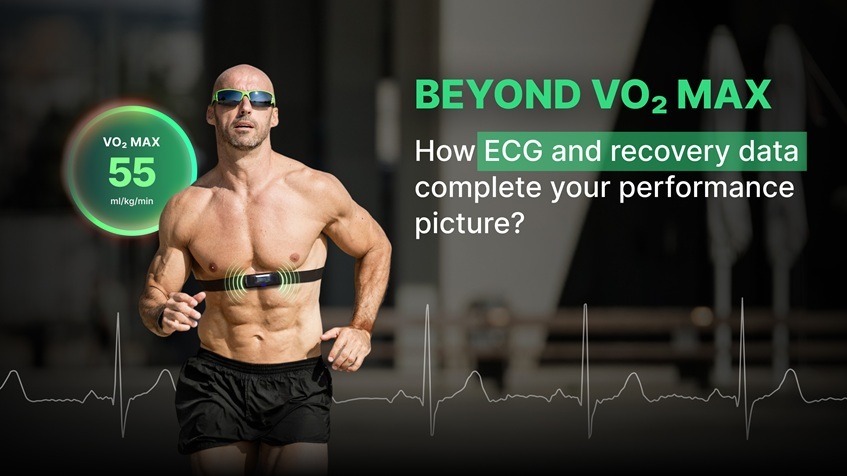

VO2 max has become one of the most talked-about numbers in endurance training.
Runners chase it. Cyclists monitor it. Smartwatches estimate it. Training platforms highlight it as a marker of fitness and performance potential.
And to some extent, the attention makes sense. VO2 max reflects the maximum amount of oxygen your body can use during intense exercise, making it closely tied to aerobic capacity and endurance performance.
But there is a problem with treating VO2 max as the complete picture of fitness.
Two athletes can have similar VO2 max values and perform very differently. One recovers well, maintains pace deep into long sessions, and adapts consistently to training. The other struggles with fatigue, inconsistent workouts, or poor recovery despite impressive numbers on paper.
That difference often comes from the areas VO2 max alone cannot fully explain: how the heart responds to stress, how the body recovers, and how sustainable the training load truly is over time.
This is where ECG and recovery-focused data start to matter.
VO2 max is useful because it estimates aerobic potential. In simple terms, it reflects how efficiently the body can take in, transport, and use oxygen during hard exercise.
Higher VO2 max values are often associated with stronger endurance performance because the cardiovascular system can support higher workloads.
But performance is not built only on maximum capacity.
It also depends on:
An athlete with a slightly lower VO2 max but better recovery and pacing control may outperform someone with higher aerobic capacity but poor fatigue management.
That is why endurance training is increasingly shifting from chasing isolated metrics to understanding broader physiological trends.
Modern athletes already track:
These metrics provide valuable information, but they still leave important questions unanswered.
Why did today’s workout feel harder than expected?
Why is recovery taking longer this week?
Why does heart rate stay elevated despite similar pace?
Why does performance fluctuate even when training volume stays the same?
The answer is often hidden in how the cardiovascular system is responding beneath the surface.
That is where ECG and recovery data provide deeper context.
Training does not happen in isolation. Every session places stress on the cardiovascular system, muscles, nervous system, and recovery processes simultaneously.
VO2 max may tell you how much work your body can potentially handle, but ECG and recovery trends help reveal how well the body is actually tolerating that work over time.
This becomes especially important during:
Without recovery awareness, athletes often mistake accumulated fatigue for reduced fitness.
ECG, or electrocardiography, measures the electrical activity of the heart directly. Instead of only showing heart rate, it provides a clearer view of how the heart behaves during exercise, recovery, and physiological stress.
For endurance athletes, this creates several advantages.
During intervals, hills, sprints, or high-intensity sessions, wrist-based optical sensors can become inconsistent because of movement, sweat, vibration, and delayed blood-flow detection.
Chest-based ECG monitoring captures heart activity directly from the chest, making readings more stable during demanding workouts.
This becomes valuable when training depends on precise heart-rate zones.
Recovery is where adaptation actually happens.
The body improves not during the workout itself, but during the recovery period that follows it.
ECG-derived trends such as resting heart behavior and heart rate variability can help athletes understand whether the body is:
This creates a more complete understanding of readiness than VO2 max alone.
Many athletes focus heavily on training intensity while underestimating the importance of recovery quality.
But poor recovery changes everything:
One of the clearest signs of endurance progress is not simply the ability to train hard. It is the ability to recover well enough to repeat quality training consistently over time.
That consistency is what ultimately drives adaptation.
Endurance performance depends on balance.
Too little stress and the body does not adapt.
Too much stress without recovery and performance eventually declines.
This is why many elite endurance athletes spend as much time managing recovery as they do planning workouts.
Recovery-focused data helps athletes understand:
Without this context, VO2 max becomes only part of the story.
Some athletes become overly focused on increasing VO2 max because it feels measurable and performance-oriented.
But endurance racing depends on much more than aerobic capacity alone.
Successful marathoners, cyclists, and endurance athletes also rely on:
This is why athletes with slightly lower VO2 max values can sometimes outperform athletes with higher numbers.
The ability to sustain effort, recover efficiently, and train consistently often matters more than a single peak metric.
Frontier X2 is a chest-worn device that records ECG and heart rate during exercise, recovery, and daily activity. Because it captures electrical heart activity directly from the chest, it provides more stable heart-rate tracking during intervals, endurance sessions, and high-intensity workouts where wrist-based sensors may become less reliable.
For athletes training with structure, this allows:
This becomes especially valuable for endurance athletes who rely on physiological feedback to guide pacing, intensity, and recovery decisions.
The culture of endurance training is changing.
Athletes are becoming less interested in collecting random numbers and more interested in understanding what those numbers actually mean.
The questions are evolving from:
“What is my VO2 max?”
to:
“How well is my body adapting?”
That shift changes how people approach training data.
Instead of focusing only on maximum output, athletes are paying more attention to:
Because in endurance sports, progress rarely comes from one great workout.
It comes from months of repeatable training supported by effective recovery.
One of the biggest misconceptions in endurance training is that improvement comes only from pushing harder.
In reality, adaptation happens between sessions.
The body needs time to absorb training stress, rebuild tissue, restore energy systems, and recalibrate cardiovascular response.
This is why recovery awareness has become such an important part of modern performance training.
Athletes who recover well can:
And over time, these advantages compound significantly.
VO2 max remains valuable. It provides insight into aerobic potential and cardiovascular capacity.
But performance is broader than a single number.
The heart’s response to stress, the body’s ability to recover, and the consistency of long-term training all shape endurance outcomes just as strongly.
ECG and recovery-focused data help connect those missing pieces.
They add context to effort.
They reveal trends beneath performance metrics.
And they help athletes understand not only how hard they can push, but how sustainably they can continue improving.
VO2 max is one piece of the endurance puzzle, but it is not the entire picture.
Training quality depends not only on how much work the body can perform, but also on how effectively the cardiovascular system handles stress and recovery over time.
That is why ECG and recovery data are becoming increasingly important for endurance athletes. They provide deeper insight into how the body responds beneath pace, power, and fitness estimates.
And in sports where long-term performance depends on balancing effort, adaptation, and recovery, that understanding can make the difference between simply training hard and training intelligently.








JOIN OUR NEWSLETTER
Get the latest articles, tips, offers & other exclusive content from Fourth Frontier.
