
Frontier X2 vs Smart Ring: Which Wellness Tracker Knows Your Heart Better?
By: Fourth Frontier -
November 28, 2025 7:52 am

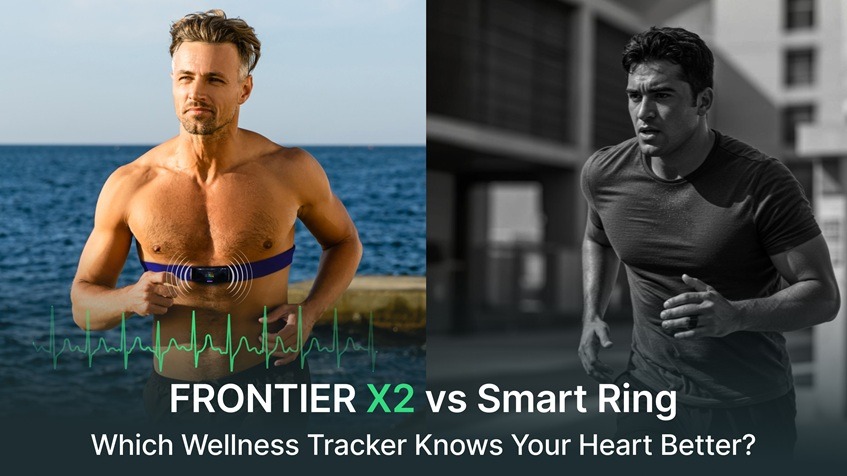
In today’s wellness-tech world, you have more options than ever to track your body, sleep, and performance. Two standout categories are chest-strap-based long-term ECG devices and smart rings. This comparison explores how the Frontier X2 stacks up against leading smart rings when it comes to wellness insights related to heart, recovery, and training performance.
Your heart does more than just beat – it reflects how your body responds to stress, sleep, and activity.
For wellness-focused users, metrics like heart rate variability (HRV), strain, readiness, sleep stages, and body shock can help fine-tune training and recovery for better long-term well-being.
Smart rings vary by brand but generally provide:
Smart rings shine in comfort and passive monitoring, but they typically lack chest-based ECG signals and body-shock or load-based analytics.
| Metric | Frontier X2 | Smart Ring |
| ECG recording (chest-based) | Long-term ECG recording from chest placement | Usually PPG (finger-based), not ECG |
| Accuracy | Good accuracy due to its positioning close to your heart | Diminished accuracy |
| Training load & Body Shock | Tracks impact forces & training load metrics | Limited or absent |
| Sleep & Recovery | Sleep stages, HRV, readiness trends | Excellent for sleep and comfort |
| Comfort & Wear | Less discreet but high signal fidelity | Very comfortable for 24/7 wear |
| Motion Handling | Chest placement reduces motion noise | More motion artifacts during exercise |
| Integration | Works with multiple fitness apps | Good ecosystem but less training depth |
| Battery & Durability | Up to 14 days typical use (IP67) | ~ 5–7 days avg., varies by brand |
Choose Frontier X2 if you want to:
Choose a Smart Ring if you prefer:
Many wellness enthusiasts combine both – a smart ring for comfort and sleep, and the Frontier X2 for high-intensity training and heart-focused sessions.
The Frontier X2 provides wellness-grade ECG and heart-rate monitoring for individuals focused on fitness, recovery, and overall heart wellness.
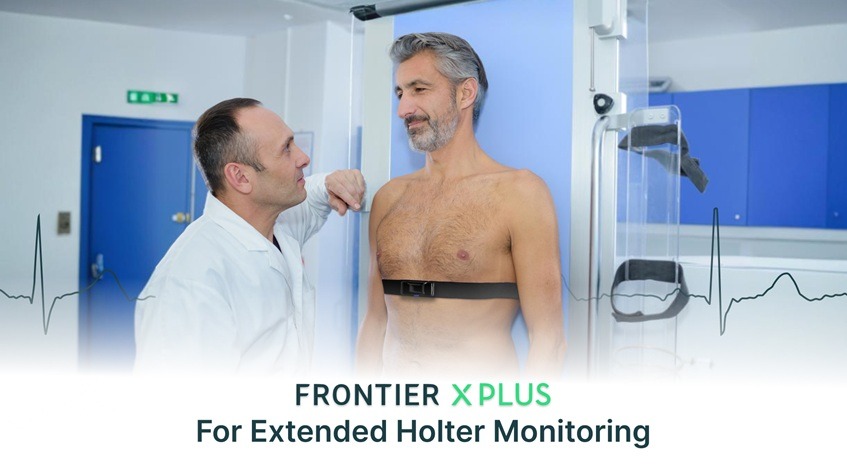
For those with cardiac conditions, the Frontier X Plus offers a medical-grade, prescription-based solution. Cleared by the U.S. FDA under 510(k), it is indicated for long-term ECG monitoring to assist physicians in the detection of Atrial Fibrillation, Bradycardia, and Tachycardia.
The Frontier X Plus is a chest-worn, long-term ECG monitor that records and transmits high-fidelity ECG signals over extended periods. The data can be securely reviewed by healthcare professionals, supporting clinical assessment of rhythm stability and therapy effectiveness during rehabilitation or ongoing cardiac management.
Q1. What’s the difference between a smart ring and a chest-strap heart monitor?
A smart ring uses finger sensors (PPG) for HR, HRV, and sleep; a chest-strap like Frontier X2 records direct ECG signals, providing higher-fidelity heart data for wellness analysis.
Q2. Can a smart ring record ECG?
Most cannot. They rely on optical sensors, while the Frontier X2 records ECG signals directly from the chest for more detailed wellness tracking.
Q3. Which is better for training load and recovery?
Frontier X2 measures body shock, strain, and recovery metrics; smart rings focus more on passive data and sleep.
Q4. Are smart rings accurate for heart rate and sleep?
Yes – they perform well for HR and sleep tracking, though motion accuracy may vary.
Q5. Can I use both devices?
Absolutely – many users wear a smart ring all day and the Frontier X2 during workouts for deeper heart insight.






JOIN OUR NEWSLETTER
Get the latest articles, tips, offers & other exclusive content from Fourth Frontier.
